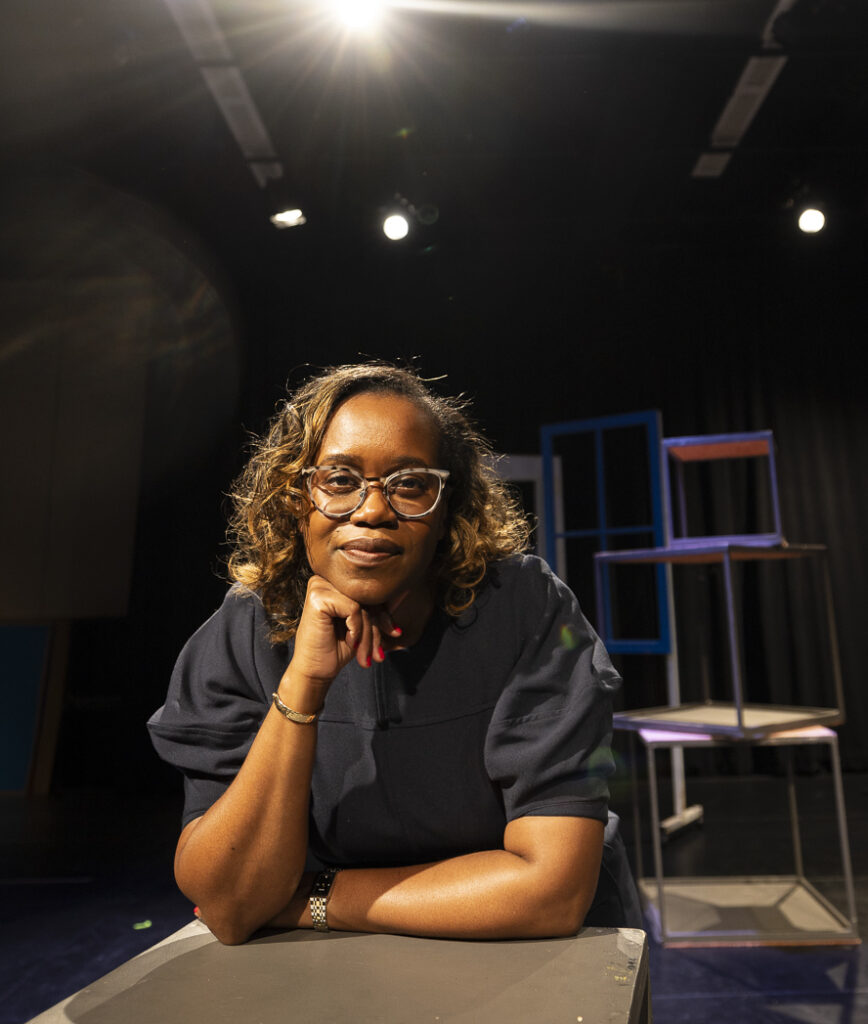
Rashida Z. Shaw McMahon ’99
Rashida Z. Shaw McMahon ’99 knew she would attend Wesleyan University when, on a visit to campus from her native St. Croix as a high schooler, she walked into the Center for the Arts Theater for the first time.
The space was empty, but Shaw McMahon, an aspiring actress, had no trouble filling it in her mind.
“I was like, ‘This is it,’” she remembers. “I had never been in a theater space that big or that grand.”
Shaw McMahon did major in theater, performing on that stage but also—and mostly—in student-run productions at the Patricelli ’92 Theater, including plays by Thomas Kail ’99, who went on to direct In the Heights and Hamilton, both written by Lin-Manuel Miranda ’02.
But it was the “choosing-my-own adventure” aspect of Wesleyan’s Open Curriculum that proved to be most influential.
Shaw McMahon earned a second major in sociology, including through classes with Professor Emerita Mary Ann Clawson that “opened up our collective minds.” Her integration of the two disciplines culminated in her honors thesis, which examined so-called color-blind casting, or a method of hiring actors that doesn’t take race into account. The practice can lead to a “lot of wonderful performances,” she says, but has also been criticized—including by the playwright August Wilson, who once said, “We do not need colorblind casting…we need theatres to develop our playwrights.”
For Shaw McMahon, Wesleyan was a place to “grapple with color-blind casting from the perspective of Black actors.” In the performance component of her thesis, directed by Visiting Professor Leah C. Gardiner, she was cast as “a princess who was female by birth but…wanted to be more male presenting.”
“In that one production, I was both genders, I was feminine, I was masculine,” she says. “I was becoming a thinking actor who was very much aware of race and gender and sexuality and politics. That was all coming together in theater—this thing that I loved.”
Shaw McMahon later pursued an interdisciplinary PhD in theater at Northwestern University. Instead of writing her dissertation on a “canonical” Black playwright such as Wilson—as she had proposed—she chose to examine the history and context surrounding popular Black theater, including the works of Tyler Perry, who, before moving into film, books, and television, sold out theaters to mostly Black audiences with his Madea plays.
“Here were these plays where droves of Black Americans were going to see Black characters with Black-centered plots delivering cultural references in high emotional registers,” she remembers. “I don’t know if I had gone to a different university that I would have dared to write a dissertation on Tyler Perry musicals.”
Shaw McMahon’s risk paid off: Her dissertation became a book called The Black Circuit: Race, Performance, and Spectatorship in Black Popular Theatre.
“It’s because of Wesleyan that my brain thinks this way,” she explains. “I came to Wesleyan as a theater kid, and I left Wesleyan with all of this awareness and all of these questions about the role of acting, the choices that actors make, and the ways in which representation matters. Those were things I hadn’t thought of before.”
Since joining the Wesleyan faculty in 2010, Shaw McMahon, who chairs the English department and is affiliated with the theater and African American studies departments, has tried to help students feel that same sense of possibility.
“I am imparting to my students a lot of the ways in which Wesleyan has taught me to navigate not only the world but also my curiosities and my passions,” she says. “That is something I learned as an undergraduate here and something that I find extreme pleasure and joy in now as a professor helping guide and usher and encourage students toward finding their own path.”