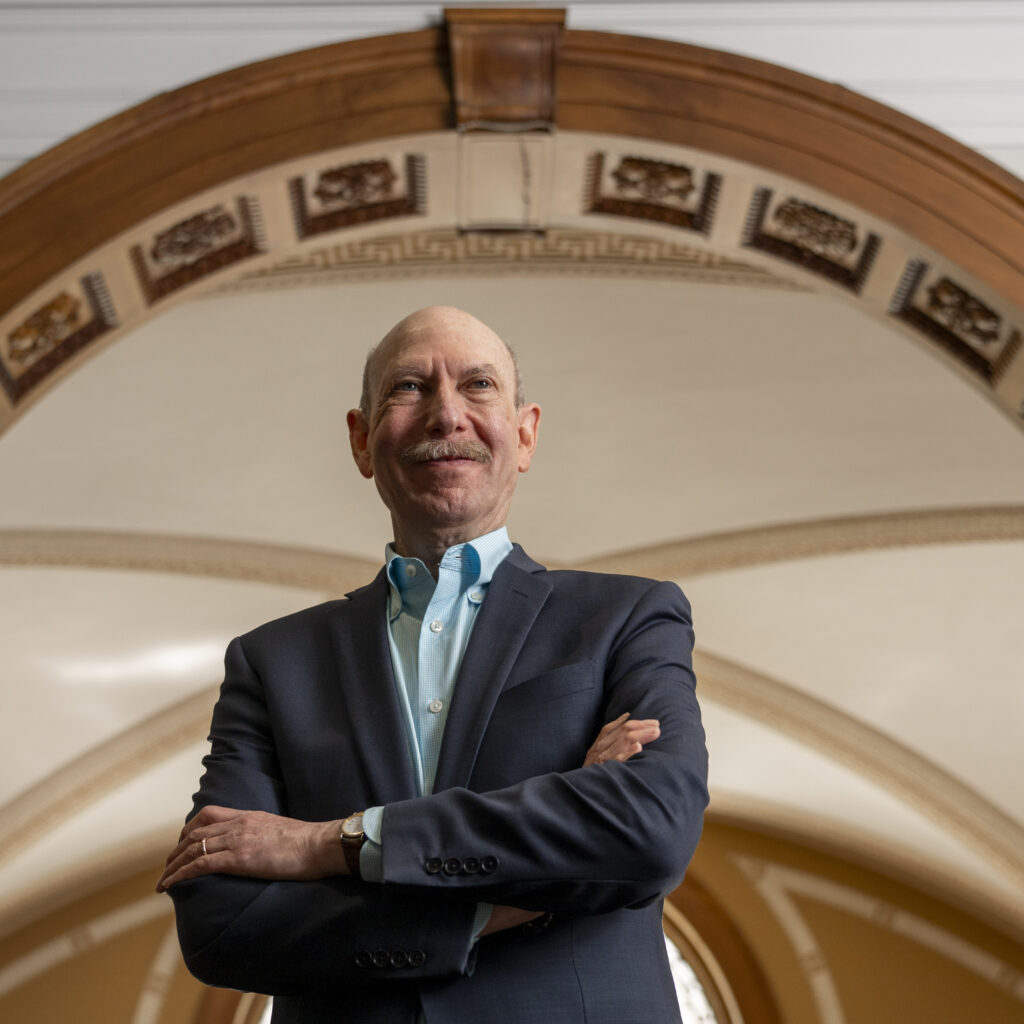
Alan C. Miller ’76
Long before Alan C. Miller ’76 won the Pulitzer Prize for his reporting on deaths linked to a military aircraft known as “The Widow Maker,” he learned an early lesson in the power of journalism.
After founding his middle school newspaper, he was called out of Spanish class one morning by the principal who told him that his editorial on ways to improve the school—including more open-mindedness by the principal—could not be published with that criticism. The editorial ran with a blank space where the paragraph mentioning the principal had been.
“Everybody wanted to know what was missing,” Miller recalls with a smile. “It got much more attention than it would have gotten had we just printed it as I wrote it.”
Undaunted by that early experience with censorship, Miller went on to make a career out of holding people in power to account. He worked as a political and later investigative reporter for outlets including Albany’s Times Union; the Record in New Jersey; and the Los Angeles Times. In addition to his Pulitzer, Miller won several national awards for breaking the story of a major scandal involving illegal Democratic campaign contributions in the mid-1990s. In 2008, he built on his journalism career to found the News Literacy Project (NLP), a nonpartisan nonprofit that seeks to ensure that future generations respect—and can readily recognize—quality journalism and credible information and can become well-informed participants in a healthy democracy. That is a task that has proved much more difficult in an age dominated by artificial intelligence and online influencers.
“I wish I looked a little less prescient and the need was a little less urgent,” he says. “I knew this critical thinking skill would only become more important over time…But I had no idea that misinformation and disinformation and conspiratorial thinking would become the most important existential challenge of our time.”
Miller credits his mother, Anita Miller, with helping to instill the values that have guided his personal and professional life. She began her career as a civil rights activist and rose to become a prominent national leader in the fight for fair housing and urban revitalization. At Wesleyan, Miller found a similar set of values: The university had established itself as a leader in efforts to make college campuses more diverse in the 1960s.
Miller thrived on campus and enjoyed his classes as an English major, including with the late Richard P. Wilbur, the second poet laureate of the United States. His most influential professor was his advisor, Joan Hedrick. Wesleyan didn’t have a formal journalism program but, through the university’s open curriculum, Miller charted his own course with help from Hedrick, who created tutorials for him, including one on investigative reporting.
“I remember reading Bob Woodward and Carl Bernstein who fired my imagination through their coverage of Watergate,” he says.
Wesleyan “was so valuable to me professionally and in my life in general,” Miller adds. “I really honed my critical thinking, my independence of mind, my curiosity and openness to new ideas. It also further stimulated my desire to make a difference.”
By the time he was a senior, Miller had experience through reporting internships at the Middletown Press and his hometown Ridgewood (NJ) News. On campus, he turned his attention to Wesleyan’s fraught history of race relations. The school’s relatively recent leadership role in recruiting Black students against the backdrop of the national turbulence of the 1960s had led to tension and even violence on campus. Collaborating with Argus editor Jane Eisner ’77, P’06,’12 and leaders within the Black community, including Theodore M. Shaw ’76 and Lacy Johnson ’76, Miller put together a four-part series called “Black and White at Wesleyan” based on extensive reporting, including interviews with the late Edgar F. Beckham ’58, the first Black dean of the college. The series also included essays on race from Black and white students and faculty.
“That was a very positive experience, certainly one of the most influential experiences of my time at Wesleyan,” Miller recalls.
The story was “a building block” of Miller’s career to come, he explains.
Throughout his career, Miller says, “I developed a sense of finding stories that had not been told. I didn’t shy from the really challenging stories.”
Miller was already pondering a “second professional act” when he got the idea to create NLP after visiting his daughter’s middle-school class to talk about journalism in 2006. Again Wesleyan, figured prominently. Shortly after the school visit, Miller participated in a panel on the future of journalism at his 30th class reunion moderated by Alberto Ibarguen ’66, the president of John S. and James L. Knight Foundation. After the reunion, Miller shared his idea with Ibarguen. Knight subsequently became NLP’s first funder and helped to launch the field of news literacy; Paul Mason ’77, and Rob King ’84 both served on NLP’s board.The nonprofit is now the biggest provider of news literacy in the country, and its award-winning digital resources are being used by middle and high school educators in every state.
Miller calls his time at Wesleyan “a gift that keeps on giving.”
The many relationships—personal and professional—that he forged on campus as a student and alumnus, he says, “underscore the values and sense of community and engagement that make Wesleyan such a very special place.”