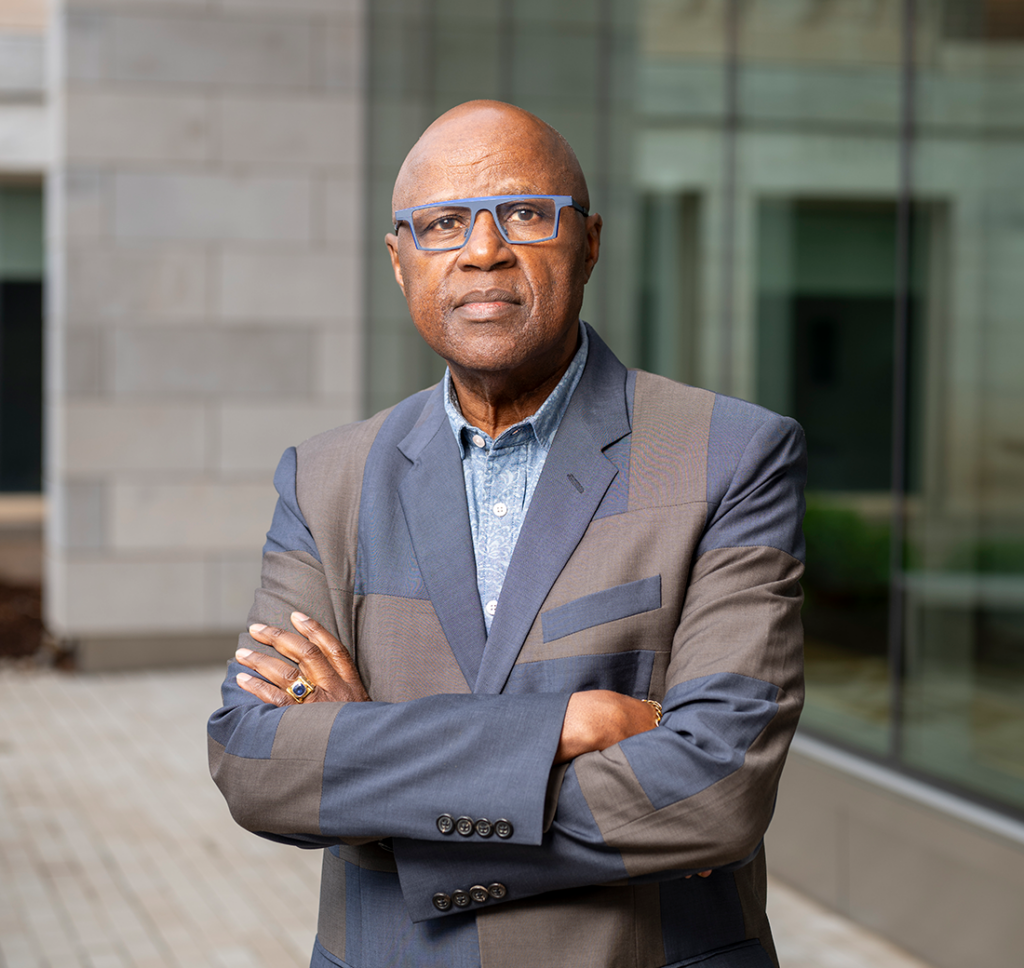
Roberto Powers ’75
Roberto Powers ’75 first learned about Wesleyan University from Melvin Dixon ’71, a poet who came to speak at the preparatory school where Powers was a student.
“This was right at the time of the Black power movement on campuses,” Powers recalls. “He showed up … with this huge Afro and a degree of self-assuredness… and I was just enamored… I thought…‘Wherever he went to school, that’s where I want to go.’”
Dixon later invited Powers to visit Wesleyan, and Powers “fell in love with the campus.” The university, where he studied sociology and English, “exceeded my expectations,” he says, and empowered him to explore his interests and myriad opportunities. That exploration, after working seven years in Paris with an intergovernmental organization, ultimately led him to the U.S. State Department where he served more than three decades as a diplomat, including tours in Egypt during the 2011 Tahrir Square uprising and in Sudan during the Darfur refugee crisis. Powers won the university’s Distinguished Alumni Award in May.
“Wesleyan ignited a flame within me for seizing opportunities,” he says. “There was sort of a sense of, ‘If you want it, go for it, and we’ll support you.’”
As a student, Powers particularly loved classes on sociology with Professor Hubert J. O’Gorman ’69 MA, on Shakespeare with Professor William Nicholas Knight, and on the Great Books. He wrote a paper highlighting aspects of Shakespeare’s “King Lear” with the fate of Malcolm X in his Autobiography, both works studied in the course.
“Having the liberty to explore such ideas was the type of thing that Wesleyan nourished,” he says. “No one was going to tell you that you couldn’t do it—they’re going to be interested in seeing how you did it.”
Powers spent a year at Smith College, studied Swahili while at Wesleyan, and completed a summer fellowship in East Africa. Those experiences came in handy years later when he found himself in Rwanda on a diplomatic mission. Many Rwandans who had been living in exile had returned to their country fluent in Swahili.
“That was the language we had in common,” says Powers, who is fluent in French, Arabic, Italian, and Spanish. “I hadn’t used it for years, but my Swahili came back to me.”
Powers retired from the State Department in 2017 and lives in France. A former scholarship student, he hopes to “pay it forward” to his alma mater.
“None of the road was easy,” he says. “But it was because I realized that it wasn’t easy that I was so motivated. And that motivation does come from Wesleyan…it really makes a difference when you’re working with professors who care about you. Especially when they see that there are things that merit polishing and can be fine-tuned …they help you identify what those things are and to improve upon them.”