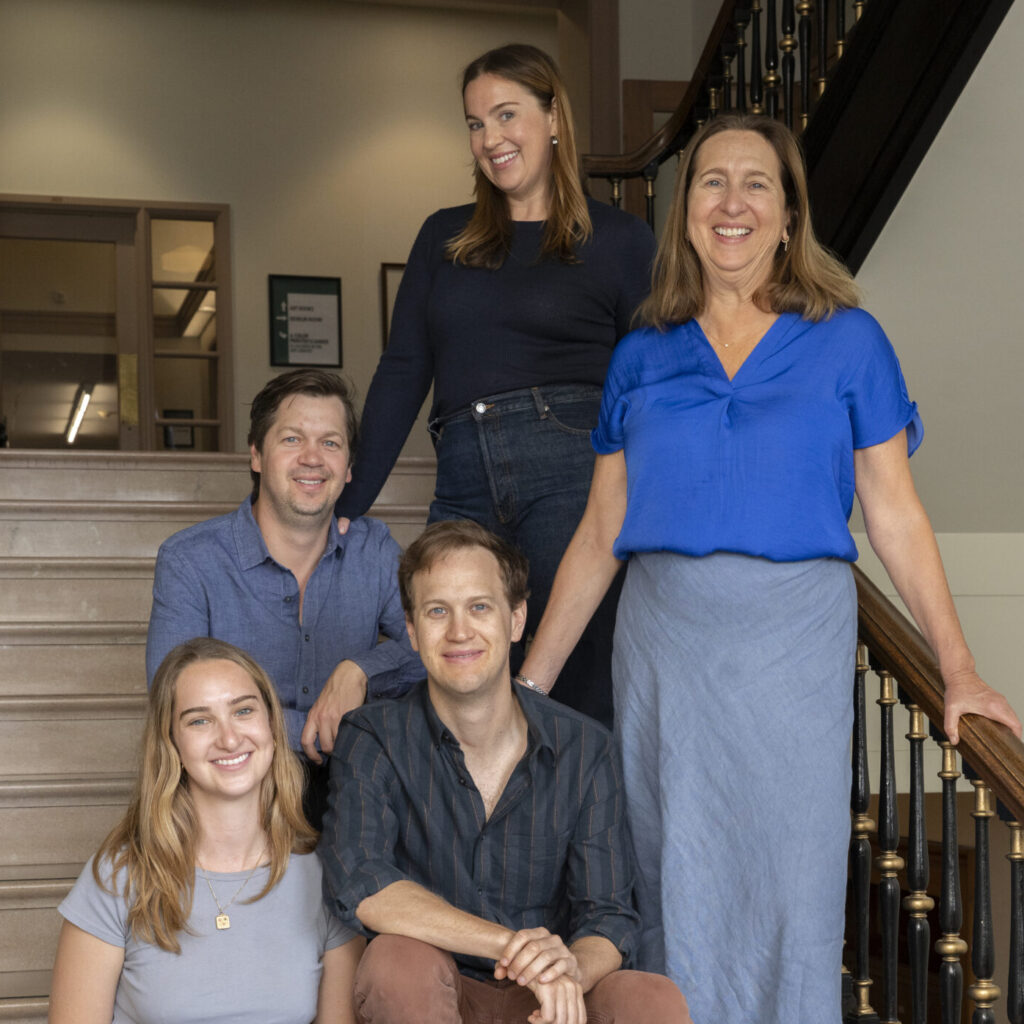
The Newmyer Family
Deb Newmyer P’10, ’11, ’16, ’25, Sofi Newmyer ’10, Teddy Newmyer ’11, James Newmyer ’16, and Billi Newmyer ’25
“I’m not mad, I’m just disappointed” were the exact words Deb Newmyer used. It was April 2006, and Teddy Newmyer, a high school senior had just decided where he was going in the fall: a small liberal arts college in the Midwest. He’d spent the last week oscillating between Wesleyan and this other school, but his older sister Sofi Newmyer ’10 was a Freshman at Wesleyan and Teddy was determined to chart his own path. His mother, who was staring at three years of different homecomings, summer schedules and flights from their home in Los Angeles, had other ideas.
“Twenty years later, all I can say is that I’m happy I have a pushy mother” says Teddy Newmyer ’11. Wesleyan proved to be the right match for Teddy—and later for their younger siblings, James Newmyer ’16 and Billi Newmyer ’25. Four siblings. Four very different personalities. Four distinct paths.
Their mother, Deb Newmyer P’10, ’11, ’16, ’25—a longtime film and television producer—likes to say the common thread is that Wesleyan is built for exploration. Deb first encountered Wesleyan in 2005, at an admissions event hosted by Frantz Williams ’99. Since then, the campus in Middletown has become something of an anchor for the family. As she has heard President Michael S. Roth ’78 orate many times, the university is designed as a place where students can discover what they care about, develop their skills and ideas, and then take those passions into the world. And so they did.
“Watching four very different kids find four different footings in the same place has been extraordinary,” Deb says. “Wesleyan has been our East Coast home for nearly two decades. The university has this rare ability to meet students exactly where they are—and then challenge them to grow into something even bigger.”
The Newmyer siblings themselves are a study in contrasts. In order of age: Sofi went on to found a footwear company; Teddy works in affordable housing development; James built a career writing for television; and Billi plans to pursue architecture. Yet each found something particular and essential at Wesleyan.
“That’s the magic of the place,” Teddy says. “No two Wesleyan experiences look the same and that’s exactly the point.”
Even their reasons for choosing the university were different. Sofi remembers visiting campus on what she still calls “a perfect winter day”—bright sun, fresh powder, and the kind of campus energy that’s hard to fake. “I remember thinking, these are my people,” she says. “Everyone I met was curious, engaged, and a little bit unconventional. There was this intellectual energy that felt very real. Students weren’t just consuming ideas. They were producing them.”
As he was making his final admission decision, Teddy received a bullet-pointed list from his older sister of 27 reasons why Wesleyan University would be the perfect place for him, equal parts persuasive argument and sibling pressure.
“She basically wrote me a manifesto,” Teddy says with a laugh. “Sofi ultimately helped me realize that Wesleyan could support completely different interests from the ones she had. I was drawn to the environmental science program and the chance to study issues that felt urgent and real.”
For James, the decision was simpler. “I visited Sofi and Teddy on campus and immediately thought, okay, this is the most fun anyone could possibly have. Everyone just seemed so excited to be together, and everyone seemed to want to talk about their classes, and wrestle with big ideas,” he says.
Billi, the youngest of the four, arrived with the benefit of years of observation. What appealed to her most was the freedom to chart her own course. “I had a front-row seat to what Wesleyan did for my siblings,” she says. “They all came out as these thoughtful, independent people who had figured out their own direction.”
Looking back, the siblings say the most lasting impact of Wesleyan wasn’t any one class or program—it was the intellectual community. “For me, the biggest gift was simply being surrounded by people who were incredibly smart and deeply thoughtful,” Sofi says. “It raises your standards. You start expecting more from yourself.”
Deb has had a unique vantage point, watching four children move through the same institution across nearly twenty years. “What’s remarkable is that Wesleyan didn’t try to make them into the same person,” she says. “Each of them was able to develop their own voice, their own interests, their own sense of purpose. That’s the sign of a truly powerful institution. It doesn’t mold people into something predetermined. It helps them become more fully themselves.”
And in the Newmyer family’s case, it’s done so four times—and counting.